
28 October 2026
One architecture, four products
Today we split Giraffe into four products for four verticals: developers, designers, cities and programmers. They share one architecture, built for simplicity, extensibility and a first principles approach.
Today we split Giraffe into 4 products to address 4 verticals.
Developers, designers, cities and programmers.
Each of these sectors is operating in an increasingly complex, fast and competitive environment.
All of them are using collections of old software to complete complex workflows.
Most new software is just more of the same: isolated tools. Even if they are great, they don’t solve the problem. The problem is building a system that runs.
We called the new interface Mondrian - because it is infinitely composable rectangles. We could have called it Lego© for the same reason.
If you are going to build a model city, Lego is an amazing choice of material.
You can go the other way. Buy a perfect model church made of balsa wood, and then a resin duck pond and a train station made of pewter.
You would have buildings that were superior in isolation, but would sum to well less than the total of their parts.
It is better to use some bricks to build your city. Your first station may look like this.
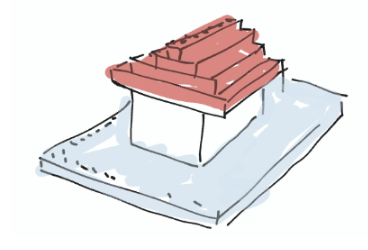
But you are working within an interoperable framework that allows you to connect it all. You’ll iterate quickly: add a bus station, extend the train station, build the city.
The word ‘framework’ is too sterile. Architecture is better. An architecture is a set of common principles that provide structure to otherwise unstructured things. It makes sense architecture is used for buildings and computing systems.
The four products Giraffe offers share a common architecture to build systems on top of. It is an architecture that prioritizes simplicity, extensibility and a first principles approach.
We are calling it a development management platform. That is the key thing: taking something - an old asset, or bare ground, and developing it into something better. A platform because you can truly build on it.
But, if you are a designer you could call it a Design Knowledge Orchestrator, or a Generative Design Distribution Workbench.
If you are a planner it is an Urban Toolkit, or a City Dashboard Configurator.
Build a system, share it, and use it to make better cities.